
Even after the initial discussions, one thing is clear: The bar is set high for providers to offer their customers a convenient, fast, and productive way to use product data for the Industry 4.0 Asset Administration Shell (AAS). This connection becomes truly valuable when it works in both directions. It is not just a matter of automatically exporting product data to the open AAS standard. It becomes much more effective when, conversely, the AAS can also be used to automatically update product data in PLM.
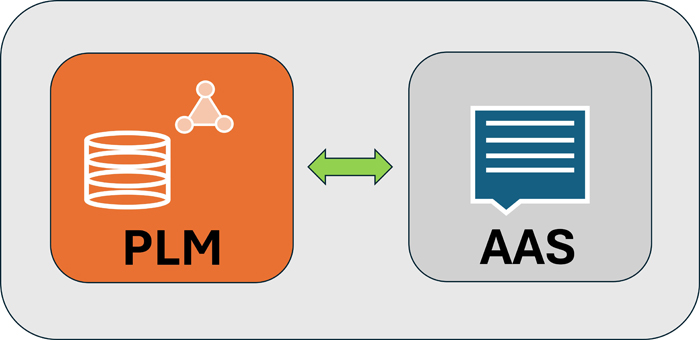
PLM Export and Import with AAS (Image: Sendler)
Industry 4.0 and Smart Factory
The Industry 4.0 initiative was launched in 2011 to lay the groundwork for a smart factory. Open standards were intended to enable the industry’s most critical core process—production itself—to operate with increasing autonomy. This includes all associated processes across the entire value chain, including the supply chain.
One aspect of the vision is that every machine should be capable of ordering the materials and tools required for the next step in the process on its own. To this end, the Industry 4.0 platform created the RAMI 4.0 reference architecture model. And, as a general interface, the Administration Shell (AAS). There are also many different submodels for various purposes, such as the “Generic Frame for Technical Data for Industrial Equipment in Manufacturing,” the “Digital Nameplate for Industrial Equipment,” or the “Product Change Notifications for Industrial Product Types and Items in Manufacturing.”
Reduce effort with PLM
The reason the smart factory is still not a reality 15 years later is that it would require all stakeholders to use AAS: manufacturers and machine builders, all component manufacturers, all suppliers, and automation providers would have to make their data available as AAS. However, this represents an additional burden that every manufacturer and provider would have to shoulder for its entire portfolio—and for which it would need to allocate staff. And that’s where PLM comes into play.
After all, isn’t the goal of PLM to centrally manage all data related to a product throughout its entire lifecycle—from maintenance all the way to recycling—for a company? Even 25 years after the launch of the major PLM initiative, this is by no means a given and certainly not implemented in the majority of industrial companies. But those who have implemented it can now access this data to use it in AAS.
Therefore, the question of whether providers automatically make this functionality available as a standard feature is a question of the actual value that the PLM installation holds for the customer. That is precisely what the current survey is about.

Representatives from Eplan and its partners at Eplan Next26 on AAS (Photo: Sendler)
Pioneers, step forward!
The response to posts on this topic on LinkedIn shows that there is considerable interest. That interest would certainly grow even more if the pioneers would allow me to report in detail on their respective pilot projects—including the very concrete benefits that all stakeholders in the value chain stand to gain.
Well-known projects are primarily in the fields of automation and electrical design, such as the Product Change Notification initiative involving Eplan, Phoenix Contact, and Contact Software as part of the Industrial Digital Twin Association (IDTA), which, by the way, is also responsible for the numerous AAS models. But there are likely a multitude of examples that are not being discussed anywhere.
I have the capacity and a great desire to write about such projects. The price would not be an obstacle to such articles. I promise.
Nowhere is PLM as deeply rooted in industry as it is in Germany. AAS was developed in Germany and established as an international standard through an open standard. As an industrial hub, we thus hold an asset in our hands that we can leverage. We should do so.